Your launch plan is in five places. None of them is the plan.
The brief is in a doc, the copy is in a chat scroll, the numbers are in a sheet, and launch day is in your head. Every week you rebuild the picture from the pieces — and brief your AI on all of it from scratch.
Put the campaign on one canvas your AI works on too. One place to look, and nothing to re-explain.
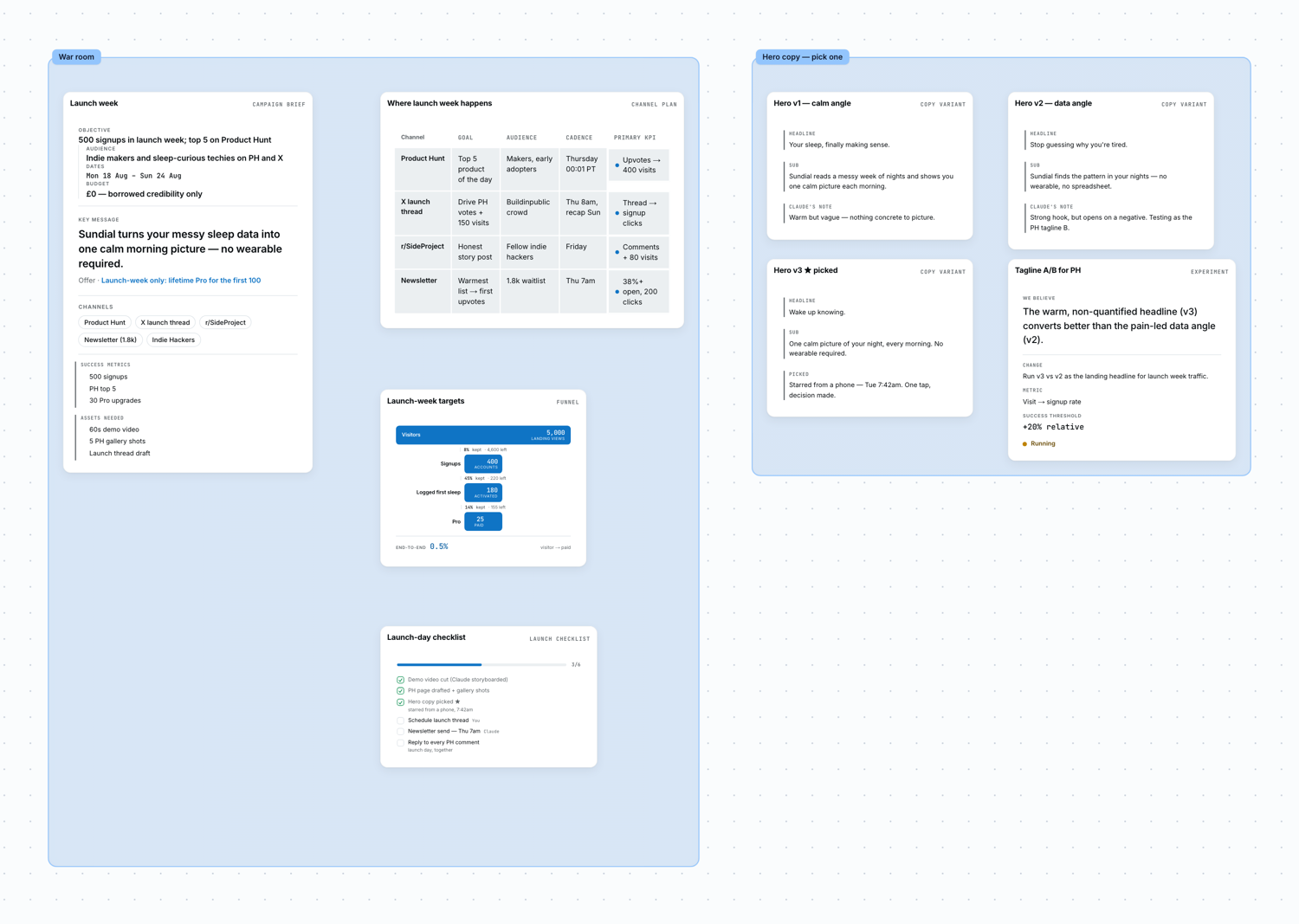
One board carries the campaign end to end.
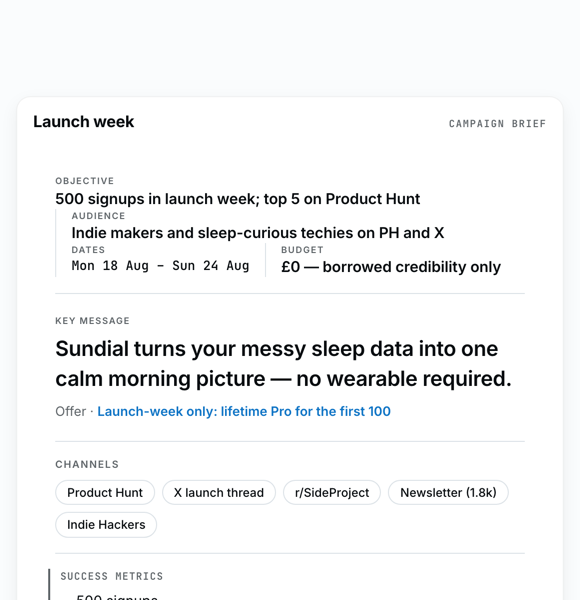
The whole campaign on one surface.
Objective, audience, dates, budget, the one message that matters — as cards, not paragraphs. You can take in the campaign at a glance, and so can anyone you show it to.
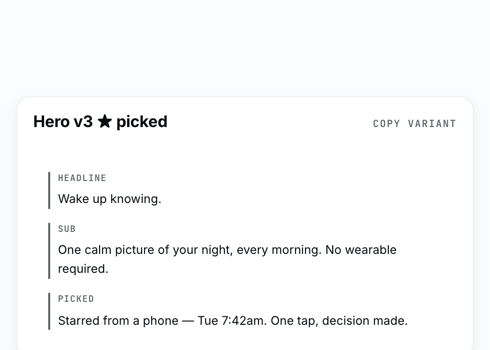
Copy you choose between, not scroll through.
Ask for three angles and get three cards side by side — each with its headline, its sub, and a note on what it's betting. Star the one you want. The choice is recorded where the next draft will read it.
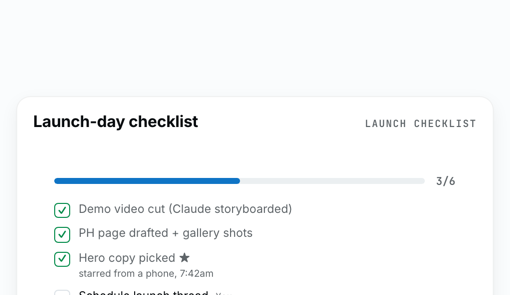
Launch day runs off a list you both tick.
Every line has an owner — some yours, some its. Things get ticked as they land, from wherever you happen to be, so at 7am you're looking at what's left rather than trying to remember what there was.
The campaign stops living in your head.
One place to look
Brief, channels, copy and numbers on a single surface — not four tabs and a memory.
Nothing gets re-briefed
Your AI already has the campaign in front of it, so you start from the work instead of the recap.
The next launch starts warm
What you tried and what it did stays on the board, so the following campaign begins with evidence.
Picked from a phone, on the way in.
Real prompts. Real cards. Try them today.
Everything on this page is something you can say to your AI on a connected canvas — copy one and start there.
“Set up a launch board for my product — campaign brief, channel plan, launch-week funnel targets and a launch-day checklist.”
“Draft three headline angles as cards, with an honest note on each one's weakness.”
“Update the funnel card with this week's numbers and flag the biggest drop-off.”
“Run the two taglines as an experiment card — visit to signup, +20% threshold.”
“What did we decide about discounts last month? Check the board.”
“Star the second headline and tick the copy task off.”
Works with the AI you already use — Claude Code at your desk, the Claude app on your phone. One canvas between them.
Every screenshot here is a real canvas
No mocked UI. The boards on this page were written by an AI over a live connection, and captured from the board itself on 3 September 2026.
Your stack stays your stack
Your AI brings its own connections — your analytics, your docs, your inbox. duetpad is where the conclusions live: visual, shared, and remembered.
What marketers ask first.
Do I need to know Claude Code?
No. duetpad works with the AI you already use — Claude Code in a terminal, the Claude app, or another assistant. Connecting takes a couple of minutes and there are no keys to juggle.
Does it work on my phone?
Yes — talk to the Claude app on your phone and it works the same canvas. The board itself opens in your phone's browser too, so you can see changes land as you ask for them.
Which cards exist for marketing?
Campaign briefs, channel plans, funnels, experiments, messaging matrices, positioning statements, competitive analyses and more are built in. When nothing fits, your AI can invent a new card type on the spot.
What if it gets something wrong?
Everything it writes is a card you can edit, move or delete — you're on the same canvas, not approving diffs. You stay the editor-in-chief.
What does it cost?
A 14-day free trial — the whole canvas, no card. After that it’s $24 a month or $228 a year, and you bring the AI you already pay for.
Run your next campaign on one canvas.
14 days free, no card. Works with the AI you already use.
Start free See a real board →