The model says one thing. Your assumptions moved months ago.
The spreadsheet still runs on the price you charged in March and the churn you guessed in January. You know it has drifted. You just don't want to open it and find out how far.
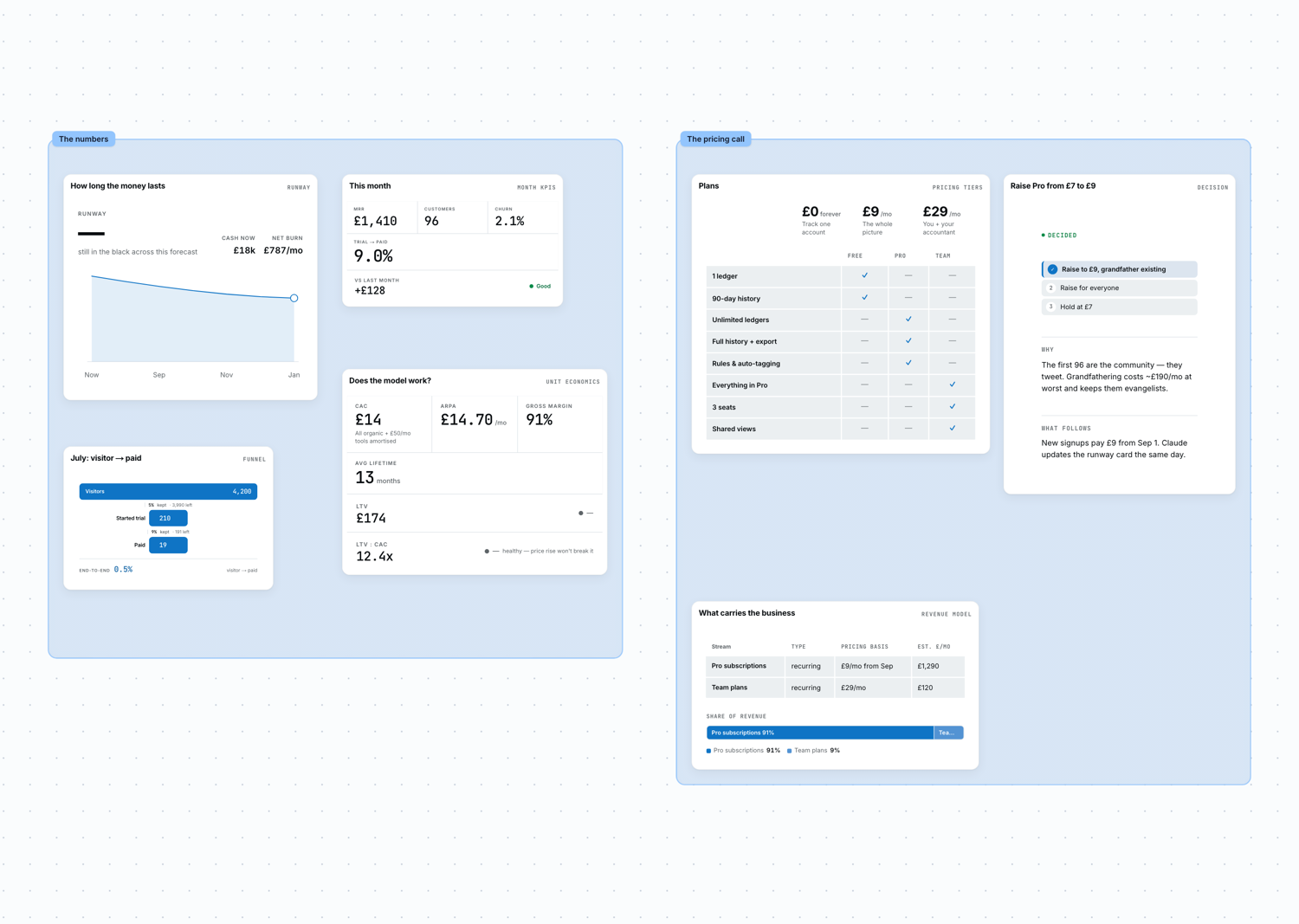
Put the numbers on a canvas where every assumption is a card you can see — and your AI keeps them honest.
From a monthly dread to a glance a week.
The month in a picture you'll actually look at.
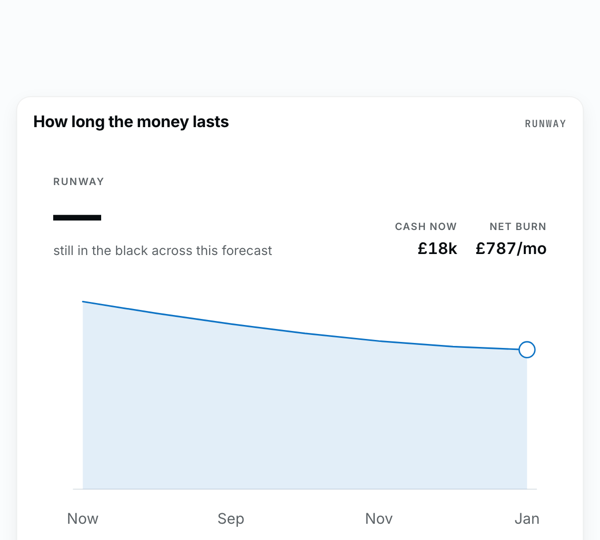
Cash, burn and the date it runs out — drawn from the numbers, not typed in and left to rot. When something moves, the picture moves, so you find out in a glance instead of in a quarter.
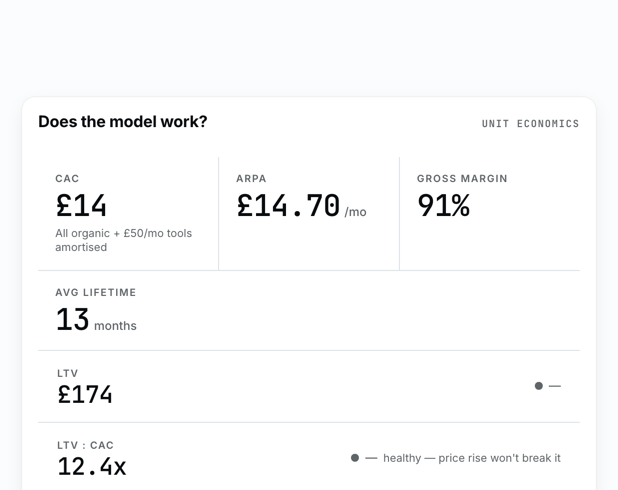
The assumption is a card, not a buried cell.
What you pay to get a customer, what one is worth, how the ratio is trending — each one visible and dated. When an assumption goes stale it is obvious, because you can see it sitting there next to the number it feeds.
Ask the scary question — and keep the answer.
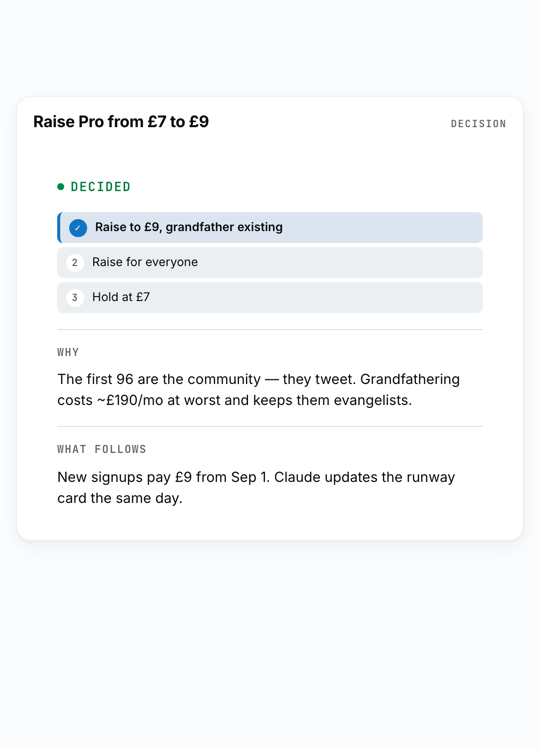
“What happens to runway if I go to £9?” The answer comes back against the real numbers, and the call lands as a decision card with its options and its why. Next quarter you can see what you were thinking.
You can look at your numbers again.
Numbers as pictures
A curve and a ratio you can read in seconds, instead of a grid you brace yourself to open.
Assumptions in the open
Every input is a card with a date on it, so drift shows up rather than hiding in a formula.
Decisions keep their why
The reasoning sits beside the number, so a call you made in spring still makes sense in autumn.
Asked from a cafe, decided before the coffee went cold.
Real prompts. Real cards. Try them today.
Everything on this page is something you can say to your AI on a connected canvas.
“Build my finance board: runway from £18k cash, this month's KPIs, and unit economics.”
“Update the runway and KPI cards with this month's revenue and spend.”
“What happens to runway if churn doubles? Rework the cards and show me.”
“Model a Pro price rise to £9 with grandfathering — write it up as a decision card.”
“Where's the biggest leak between visitor and paid? Check the funnel card.”
“How many months of runway do I have right now?”
Works with the AI you already use — Claude Code at your desk, the Claude app on your phone. One canvas between them.
Every screenshot here is a real canvas
No mocked UI. The curves and ratios were drawn by real cards from real content, captured from the board itself on 3 September 2026.
Your numbers stay yours
Your AI brings its own connections to your billing and analytics. duetpad is where the conclusions live — visual, shared, and remembered.
What founders ask first.
Is this an accounting tool?
No — it's the thinking layer. Your books stay wherever they are; duetpad holds the picture: runway, model, and the decisions you make about them.
Where do the numbers come from?
You, or your AI. Tell it the month's figures — or let it pull them through the connections it already has — and it updates the cards.
Can I trust the maths?
The cards do the arithmetic — conversion rates, runway months, LTV:CAC are derived from the raw figures on the card, visibly. You can check every input.
Does it work on my phone?
Yes — ask the Claude app a what-if from anywhere; the same canvas updates. The board opens in your phone's browser too.
What does it cost?
A 14-day free trial — the whole canvas, no card. After that it’s $24 a month or $228 a year, and you bring the AI you already pay for.
Look your numbers in the eye.
14 days free, no card. Works with the AI you already use.
Start free See a real board →